A test drive tells you more about a used car in twenty minutes than any listing photo or vehicle history report ever will. A CARFAX or AutoCheck report can flag a salvage title or a past accident, but it can’t tell you how the brakes feel or whether the heater keeps up on a cold morning here in Penn Yan, NY.
Start the engine cold if the seller lets you, keep the radio off for the first mile, and drive a stretch of highway plus at least one rough back road, not just the loop around the lot. Check the heater and defrost the same way you’d check the brakes.
What to check before you start the engine
Most of what a car will tell you happens before it ever leaves the parking spot.
1. A cold start tells you more than a warmed-up one
Ask whether the seller has already warmed the engine up. If not, pay attention to the cold start: hard starting, a rough idle, or a puff of smoke from the tailpipe as it settles are all worth noting. An engine that idles smoothly within a few seconds and holds steady is a good sign. One that surges, stalls, or takes a few tries to catch is worth asking about before you go any further.
2. Dashboard warning lights at startup
Every warning light should flash on briefly when you turn the key, then go out once the engine’s running. That’s just the system checking itself. What isn’t normal is a check engine light, an ABS warning (anti-lock brakes), or an airbag light staying on. Don’t assume it’s minor. Ask what it means and get a straight answer before you talk price.
3. A quick walk-around first
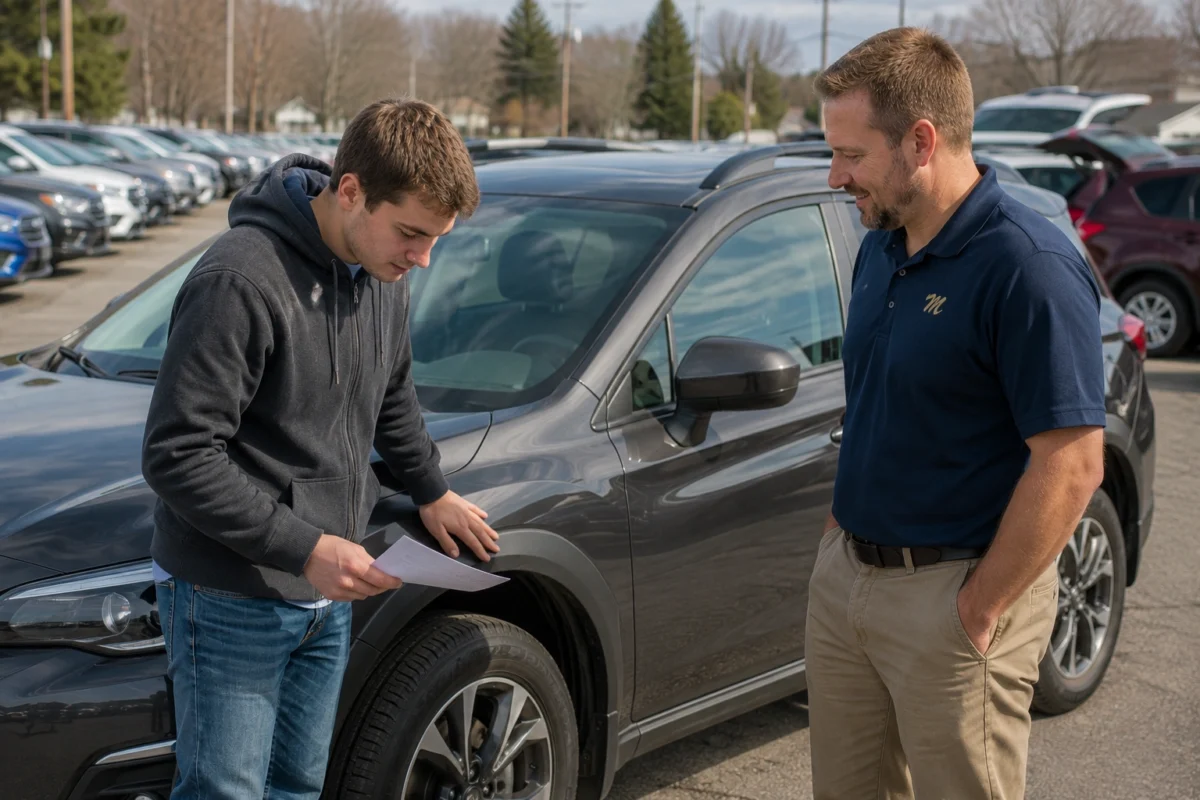
Before you get in, walk the car once. Look for mismatched paint, dents, or rust starting at the wheel wells and rocker panels, the spots road salt hits first in this climate. We’ve already covered the road-salt rust checks worth running in this region in more depth elsewhere. The short version for a test drive: consistent paint and panel gaps front to back is a better sign than the opposite. While you’re at it, confirm the VIN (the vehicle identification number on the dash) matches the paperwork.
What to check while you’re driving
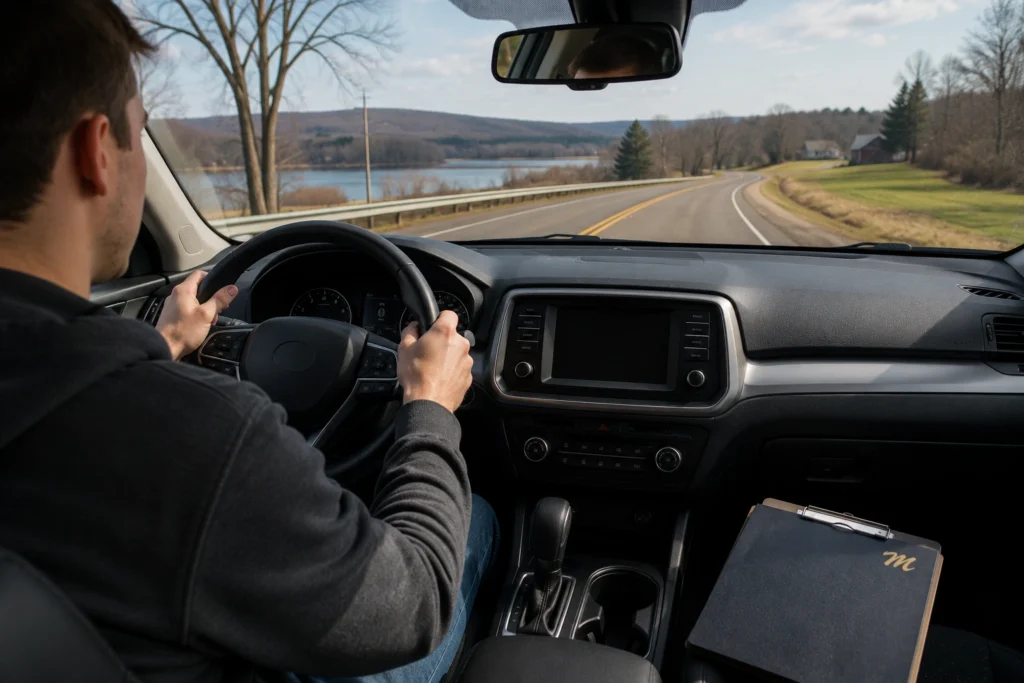
This is where a test drive earns its name. Everything up to this point was inspection; now you’re finding out how the car actually behaves.
1. Acceleration, merging, and how the transmission shifts
Find a stretch where you can merge onto the highway, not just accelerate down a quiet street. A healthy engine pulls smoothly from a stop, and again from highway speed, without hesitation. Pay attention to how the transmission shifts while you’re at it. Shifts should be smooth and mostly unnoticeable. A hard clunk between gears, a delay before it engages, or the engine revving faster than the car actually speeds up is worth asking about, especially on higher-mileage automatics.
2. Braking: Pedal feel, straight stops, and a safe spot to test hard
The brake pedal should feel firm, not soft or spongy, and it shouldn’t sink toward the floor under steady pressure. On a clear stretch with nothing behind you, brake hard once. The car should stop in a straight line, without pulling to one side, shaking, or grinding. Don’t try this in traffic. An empty road or parking lot works, the same spot you’d use to check mirrors and blind spots anyway.
3. Steering that tracks straight
On a flat, straight road, ease your grip for a second and see whether the car holds its line or drifts to one side. Steering should feel consistent through a turn, not loose on one end and stiff on the other, and it shouldn’t vibrate at speed. A car that wanders or pulls could just need an alignment. It could also point to something in the suspension worth a second look.
4. Suspension over rough pavement
Every test drive should include at least one rough patch: a pothole, a frost heave, gravel, whatever’s nearby. The ride should stay firm without turning harsh, and the car shouldn’t bounce more than once or twice after a bump. Rattles, clunks, or a loose, floaty feeling over bumps usually mean the shocks, struts, or suspension bushings have seen better days.
5. Noises worth turning the radio off for
Turn the radio off for part of the drive. It’s the easiest way to catch a knock, a tick, or a whine you’d otherwise miss, and it costs you nothing. Roll a window down for a minute, too. A burnt-oil smell, a coolant smell, or a musty cabin are all worth asking about, even if the rest of the drive felt fine.
A real test drive runs longer than you think
The standard test drive most dealers offer runs 15 to 30 minutes. That’s long enough to form a first impression. It’s still short.
Minutes aren’t the whole story, think in Miles
Buyers who’ve done this more than once tend to measure a test drive in miles, not minutes. A short loop around the block barely gets the drivetrain up to normal operating temperature. Five to 15 miles across a few kinds of roads gives you a real read on how the car behaves once it’s warmed up.
If it’s a serious contender, ask for a longer drive or a second one, and don’t hesitate to park partway through and restart it. A rough restart can point to a starter or battery issue; a single cold start won’t. Nobody selling a car in good faith should balk at any of that.
Let our own technicians take a second look
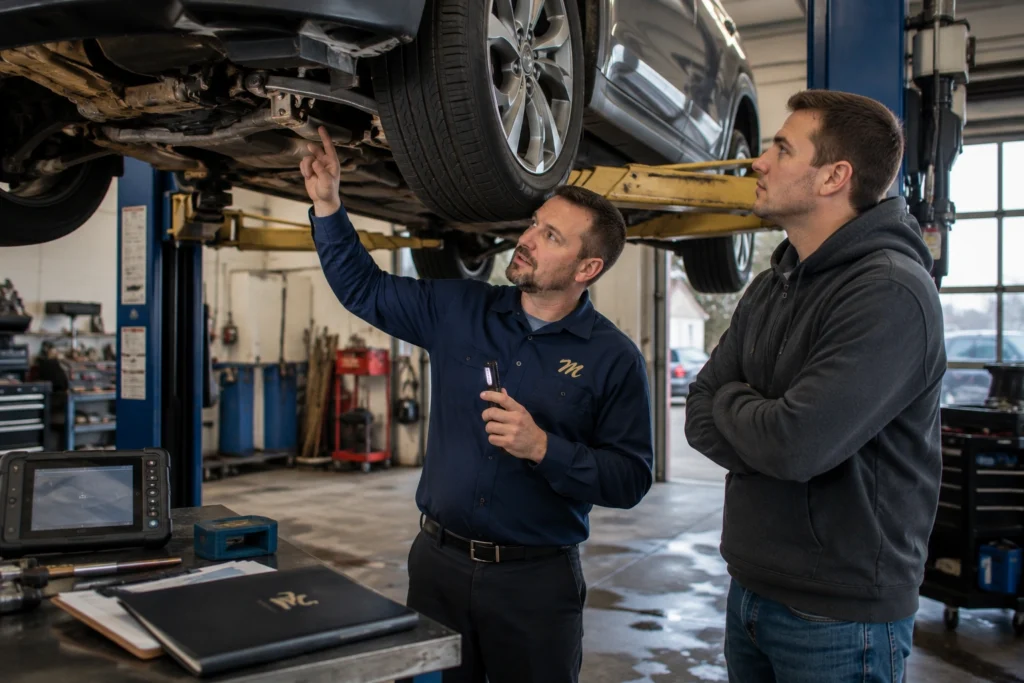
Here’s the part most used car lots can’t offer. Marbles Automotive runs an on-site repair shop staffed by ASE-certified technicians, the same people who’ll be servicing this car down the road if you buy it here. Ask them to look over the exact vehicle you just test-drove, the same day, instead of arranging an outside inspection on somebody else’s schedule.
It’s not a stranger’s general once-over. It’s the shop that already knows this car and will keep knowing it. And before any of that, our car loan calculator gives you a real monthly payment estimate, without the rate markup dealers sometimes tack onto financing.
Frequently asked questions
What features should I test besides how the car drives?
Run the air conditioning and heat on full blast, roll every window up and down, and try every door lock, including keyless entry. Test the backup camera or blind-spot alert if it has one, before you decide you like the car. Skip this, and you’ll find out about a broken feature after you own it, not before.
Should I bring anything with me on the test drive?
Bring the car seat, the stroller, or the gear you haul most weekends, and see where it actually goes. A car that handles beautifully but barely fits your daily gear is still the wrong car, and that’s the one thing a listing photo can never show you.
Can someone else look the car over besides me?
Yes, and it’s a reasonable thing to ask any seller. At Marbles, our ASE-certified technicians work on-site, so you can have them look the exact car over the same day you test-drive it, rather than arranging an outside inspection on a separate schedule.
What’s different about test-driving a used car in a Finger Lakes winter?
Check how fast the heater and defrost warm the cabin, and if it has AWD or 4WD, ask to feel it engage on a safe stretch of road. Winter or all-season tires already on the car say something about how the last owner prepared for this climate.
Does the NYS inspection sticker matter during a test drive?
It’s worth a glance at the sticker on the windshield, especially with a private seller. A current sticker doesn’t replace your own checks, but one that’s about to expire or has already expired is fair to bring up before you finalize anything.
You’ll learn more about a used car in one real test drive than in an afternoon of reading reviews. Take it slow, drive farther than just around the lot, and don’t skip the rough road.