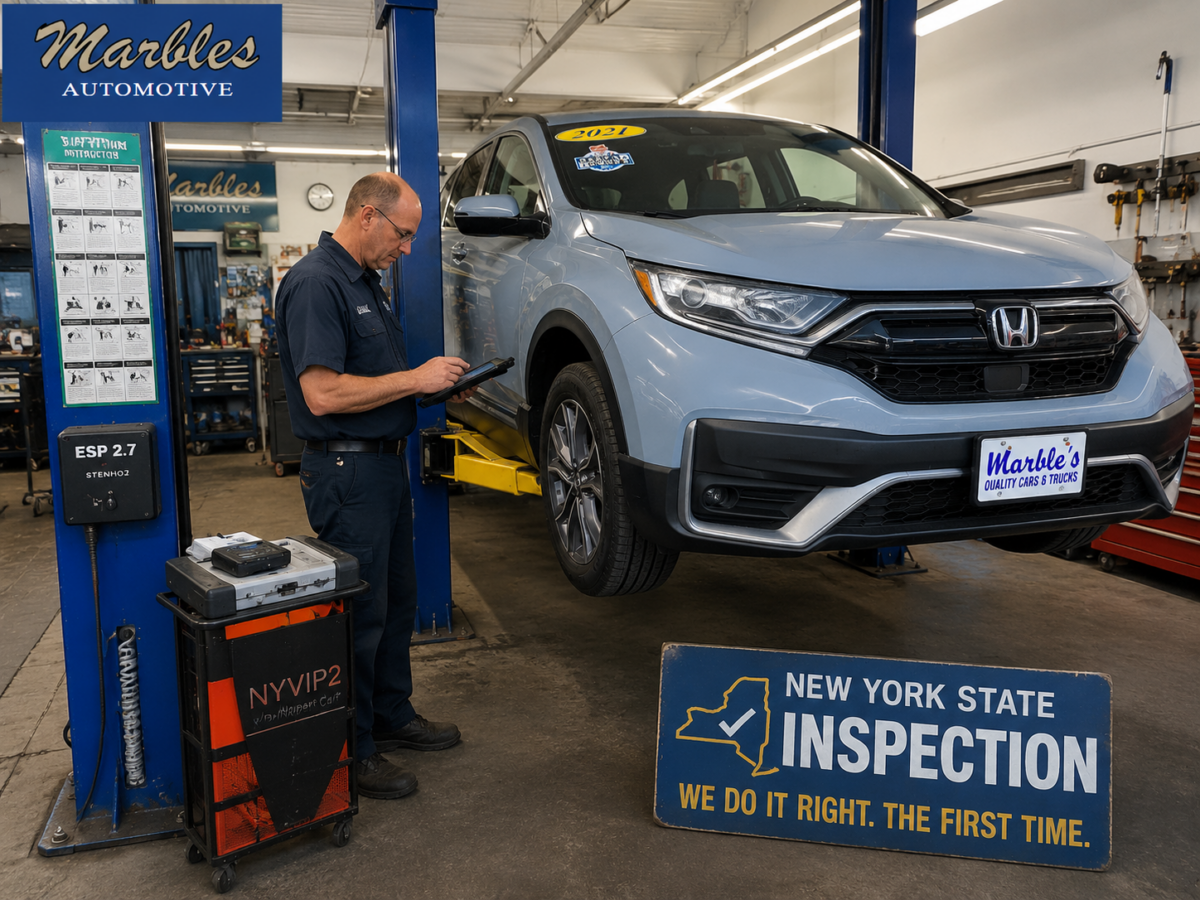
Most cars that fail New York State inspection fail for the same handful of reasons: tires worn past 2/32 of an inch, brake pads too thin, tint darker than 70%, or a check engine light that isn’t actually off the way the owner thinks it is. Nearly all of these you can catch yourself before your appointment. And you don’t have to wait until your sticker is about to expire to find out. New York lets you get inspected up to 60 days early.
That’s really the whole guide in two sentences. Everything below is the detail behind them: what inspectors are actually looking at, what causes an automatic rejection versus what’s just a note on the paperwork, and the one issue that trips up more Yates County drivers than anything else, check engine lights, mostly because nobody explains it clearly.
When to Get Your Car Inspected (and Why Waiting Hurts)
You can go in up to 60 days before your sticker expires
A lot of people don’t realize this. Your inspection sticker shows a month, and your instinct is to wait until close to that date. You don’t have to. New York allows inspections up to 60 days before the expiration date printed on the sticker, and going early doesn’t shorten anything. Your new sticker still expires the same month next year, just like it would if you’d waited.
The advantage is timing. If something comes up during the inspection (a brake job, a tire, an exhaust leak), you’ve got room to schedule the repair without the pressure of an expiring sticker sitting on your windshield. We see the opposite happen constantly: someone waits until the last week of the month, fails on something minor, and now they’re trying to get a part ordered and installed in a matter of days. Coming in a month or two early removes that entirely.
What happens if your sticker expires before you go
If your inspection lapses, you’re driving on an expired sticker, which is a ticketable offense in New York regardless of whether the car itself is mechanically fine. You also can’t renew your registration with an expired inspection on file. Neither of these requires you to have actually failed anything. It’s purely about the paperwork being current.
What NY Inspectors Actually Check
New York’s inspection is really two separate tests run back to back: a safety inspection and an emissions inspection. A vehicle has to pass both to get a new sticker.
Safety inspection items include:
- Tires (tread depth and condition)
- Brakes (checked with at least one wheel removed)
- Steering and suspension
- Lighting (headlights, taillights, brake lights, turn signals, and hazards)
- Windshield condition and wiper function
- Mirrors
- Horn
- Seat belts
Emissions/OBDII inspection items include:
- The check engine light (Malfunction Indicator Lamp) and whether it’s illuminated
- The status of the vehicle’s OBDII readiness monitors (more on this below; it trips up more people than the light itself)
- The gas cap, on gasoline vehicles
- Visual inspection of emissions control components
One thing worth knowing: not everything on the list is a rejection trigger. Low tire pressure gets flagged as an advisory note, not a failure. Same with the airbag warning lamp. If it’s not working correctly, the inspector will tell you, but it won’t fail the inspection on its own. Knowing the difference matters if you’re trying to figure out ahead of time what’s actually going to keep your car from passing versus what’s just a heads-up.
The 5 Most Common Reasons Cars Fail in the Finger Lakes
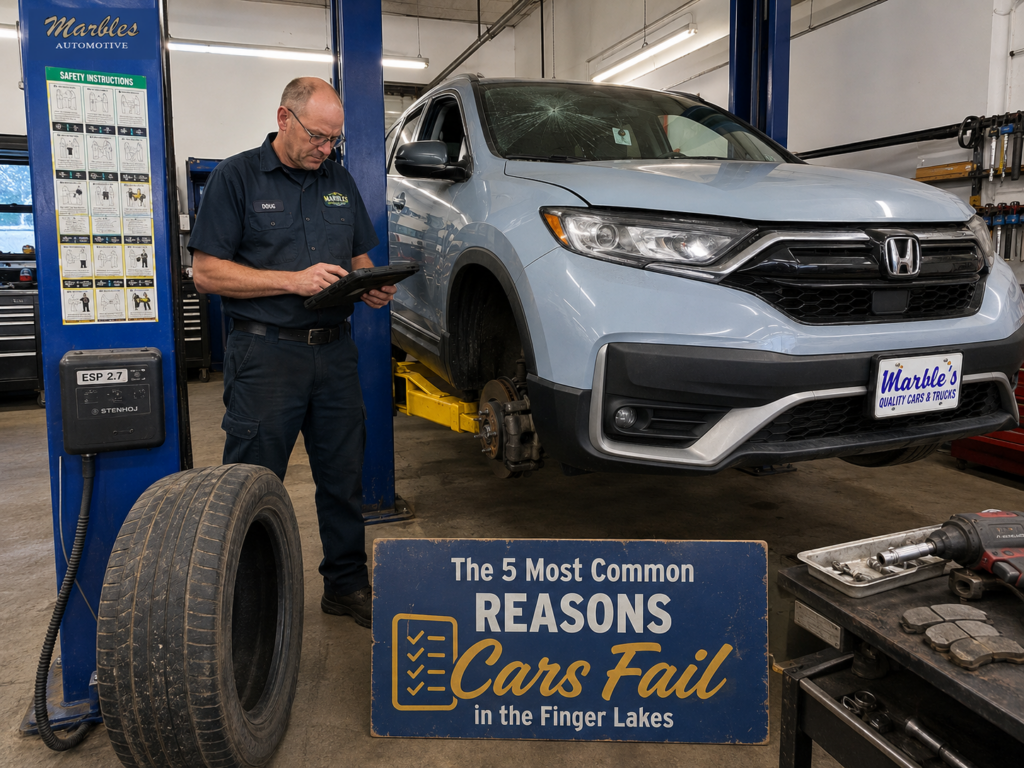
Winters here are hard on vehicles. Road salt on Route 14A and the surrounding county roads accelerates rust and wears down components faster than in milder climates, and that shows up at inspection time. These five issues account for most of what we see.
- Tire tread depth: New York requires at least 2/32 of an inch of tread. You don’t need a gauge to get a rough read at home. Take a penny, turn it upside down, and push it into the tread groove. If you can see all of Lincoln’s head, the tire is too worn to pass.
- Brake pad thickness: This one you can’t fully self-check, since the inspector pulls at least one wheel to look at the brakes directly. If you’ve noticed grinding, squealing, or a longer stopping distance, get it looked at before your appointment rather than after a rejection. We handle brake repair regularly, and catching it early is almost always cheaper than catching it as a failed item on a rejection notice.
- Window tint darker than 70% VLT: New York’s tint law is strict. Front side windows and the windshield below the top strip both have to measure at least 70% visible light transmission. Inspectors check this with a calibrated meter, not by eye, so eyeballing it and hoping isn’t reliable. Rear windows have no darkness limit on most passenger vehicles, so this really only affects the front.
- Windshield cracks in the wiper sweep area: A crack of 11 inches or longer is grounds for rejection if any part of it falls within the area your wipers actually clean. Smaller chips outside that zone are often fine. If you’ve been driving around with a chip you’ve been meaning to deal with, our windshield chip and crack repair service is worth a look before it spreads into rejection territory, especially since cold weather here tends to turn small chips into long cracks overnight.
- Exhaust and muffler leaks: A leaking exhaust system isn’t just noisy. It’s also a safety and emissions issue, and it’s one of the more common failures we see on vehicles that have been through a few Finger Lakes winters. If you’ve noticed your car sounds louder than it used to, that’s usually worth a look before, not after, your inspection appointment. Our exhaust and muffler repair service can tell you quickly whether it’s a quick fix or something bigger.
Steering and suspension issues are less common but not rare, especially on vehicles that have hit a few too many potholes on the back roads around Yates County. If your car pulls to one side or feels loose over bumps, our suspension repair and wheel alignment services address the two issues that usually cause it.
The Check Engine Light Problem Nobody Explains Clearly
This is the section most guides skip, and it’s the one that causes the most confusion.
Why the light being off isn’t enough
Here’s the part that surprises people: your check engine light can be off and your car can still fail the emissions portion of inspection. That’s because New York isn’t just checking whether the light is on right now. It’s checking whether your vehicle’s OBDII system has completed its internal self-tests, called readiness monitors. There are roughly eight of these, covering things like the catalytic converter, oxygen sensors, and the evaporative emissions system. Each one has to report back as ready or complete. If too many are still sitting at not ready, the inspection fails, even with a dark dashboard.
Why clearing the code the day before backfires
If a shop clears a trouble code, or if your battery gets disconnected for any reason (a dead battery, a repair that required disconnecting it, even a new battery installation), every one of those readiness monitors resets back to not ready. The light goes off, which feels like good news, but the underlying test hasn’t actually been completed. Be skeptical of anyone who tells you clearing the code the morning of your inspection is a workaround. It isn’t. The inspection machine reads monitor status directly, not just the light.
How long you actually need to drive after a repair
After a real repair and a code clear, the monitors need to run through a normal driving cycle to reset to ready. There’s no single official number that applies to every vehicle, but a good rule of thumb we give customers is to drive at least 100 to 150 miles of mixed city and highway driving before coming in. That’s usually enough to let the monitors complete on most vehicles. If your check engine light is on right now and you’re not sure why, our engine diagnostics service can pull the actual codes and tell you what’s going on instead of guessing.
A Quick Pre-Inspection Checklist You Can Run at Home
You can knock out most of this in about 15 minutes in your driveway before you ever book an appointment.
- Check tire tread with the penny test on all four tires, including the spare if it’s ever likely to go on the road.
- Look at tire sidewalls for bulges, cuts, or visible cord.
- Turn on headlights, taillights, brake lights, turn signals, and hazards, and walk around the car to confirm each one works.
- Check your windshield for cracks, especially anything in the direct path of your wipers.
- Run your wipers and washer fluid to confirm they clear the glass properly.
- Check both side mirrors and your rearview mirror for cracks or looseness.
- Test your horn.
- Confirm all seat belts latch and retract normally.
- Listen for any new rattling, grinding, or exhaust noise while the car is running and idling.
- If your check engine light is on, don’t clear it yourself. Bring it in so the actual cause gets diagnosed, not masked.
None of this replaces the actual inspection. What it does is tell you, before you’re sitting in the waiting room, whether you’re likely dealing with a quick pass or something that needs attention first.
What Happens If You Fail (And What Doesn’t Cost You Extra)
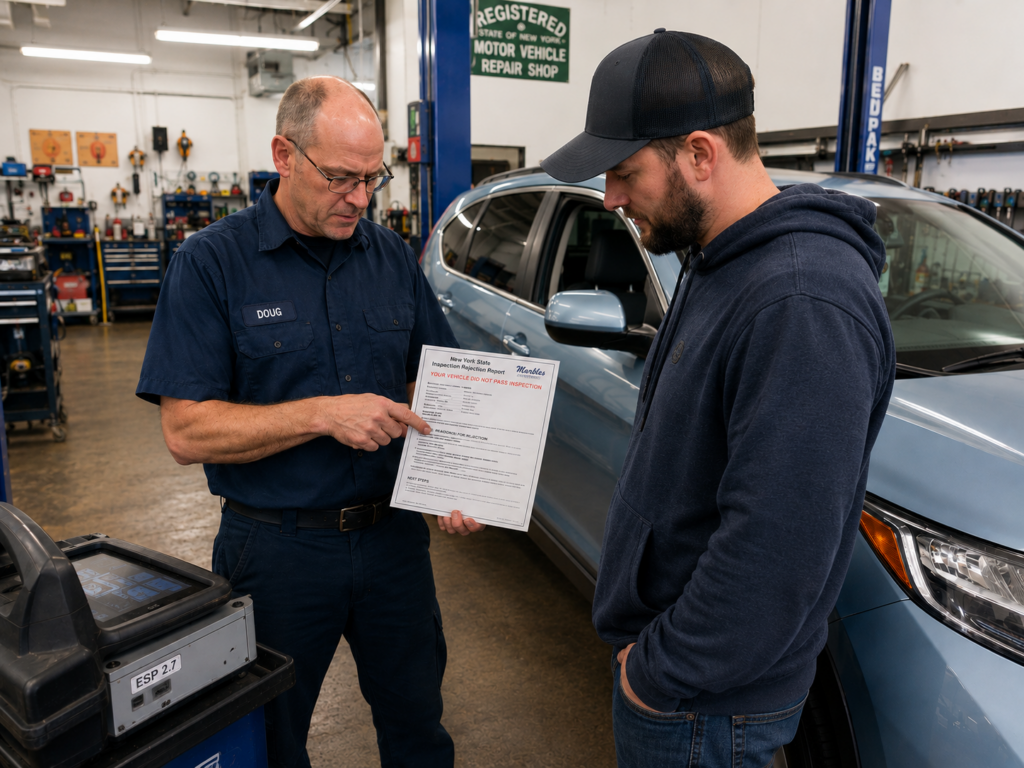
The 30-day reinspection window
A failed inspection isn’t the end of the road. You’ll get a rejection notice describing exactly what failed, and you have 30 days to get it repaired and come back for reinspection of that specific item. We cover what that visit typically costs in our inspection fee breakdown, but the short version is that a reinspection within the window is usually simpler and cheaper than starting over. Miss the 30 days, though, and you’re back to a full inspection from scratch.
Registration and fine risk
An expired or failed inspection with no valid sticker can mean a ticket, and it will block your registration renewal until it’s resolved. Neither of those is catastrophic, but both are avoidable with the kind of planning covered above: get in early, fix what needs fixing, and sidestep the whole issue.
FAQ
How early can I get my car inspected before my sticker expires in New York? Up to 60 days before your current sticker’s expiration date. Getting inspected early doesn’t shorten your inspection cycle. Your new sticker will still expire in the same month next year.
Can my car pass NYS inspection with the check engine light on? No. An illuminated check engine light is an automatic failure on the emissions portion. And clearing the code yourself right before your appointment doesn’t help. It resets your OBDII readiness monitors to not ready, which causes its own failure even with the light off.
How dark can my window tint be and still pass inspection in New York? Front side windows and the windshield below the top strip need to measure at least 70% VLT. Rear windows have no darkness limit on most vehicles. Inspectors measure this with a calibrated meter, so it’s not a judgment call.
What happens if my car fails NYS inspection? You’ll get a rejection notice listing the specific failed item. You have 30 days to repair it and return for reinspection of that item only. After 30 days, you’ll need a full inspection again.
How much tire tread do I need to pass inspection? At least 2/32 of an inch. The penny test is a fast home check: insert a penny upside down into the tread groove, and if you can see the top of Lincoln’s head, it’s time for new tires.